

Five models. One prompt. One winner the algorithms can’t shut up about. Several surprising losers.
The 2026 FIFA World Cup is 26 days away. The expanded 48-team format starts June 11 in Mexico City. Three host countries, 16 cities, the biggest single sporting event in human history by participating nations. Every football publication on Earth is currently publishing predictions. Pundits, ex-players, supercomputers, Goldman Sachs, Opta’s xG model, your uncle who hasn’t watched a match since France 98.
We decided to ask a different panel. We took five of the most-used AI models on the planet and gave each of them the exact same standardized prompt. No follow-ups. No clarifications. No leading. Just: who wins, who’s the runner-up, who’s the dark horse, who underperforms, and a one-sentence rationale for each.
The answers say a lot about the World Cup. They also say a lot about how AI models reason about sports, what data they trust, and where they diverge wildly.
Here’s everything we found.
TL;DR for the people on a coffee break: We asked ChatGPT (GPT), Google Gemini, xAI Grok, Meta Llama, and DeepSeek to predict the 2026 World Cup winner on May 13, 2026. France was the consensus pick (3 of 5 models), with Spain and Brazil each getting one vote and DeepSeek picking France with England as runner-up. All five models put France on the podium as either champion or runner-up. Argentina was the most-picked underperformer. Morocco was the most-picked dark horse. Full verbatim responses, comparison table, and analysis below.
The methodology, kept honest
Five AI models. One prompt, pasted verbatim into each. No reruns, no cherry-picking, no curation of the responses. Whatever each model said the first time, that’s what’s in this article.
The exact prompt used:
“Predict the winner of the 2026 FIFA World Cup. Give me: (1) your predicted champion, (2) the runner-up, (3) the dark horse you think will overperform, (4) the big-name team you think will underperform, and (5) a one-sentence rationale for each. Be specific. No hedging.”
Models tested (May 13, 2026):
- ChatGPT (OpenAI’s flagship model)
- Google Gemini
- xAI Grok
- Meta Llama
- DeepSeek
What this experiment can and can’t tell us: This isn’t a prediction-accuracy benchmark. None of these models has ever correctly predicted a World Cup champion in real time (the tournament hasn’t happened yet). What it does show is which teams the most-used AI assistants are flagging as serious contenders based on their training data, search access, and reasoning approaches. Read it as a snapshot of the AI-mediated consensus, not as a forecast.
The headline result: France, France, more France
Let’s start with the picture you came here for.
| Model | Champion | Runner-up | Dark horse | Underperformer |
| ChatGPT (GPT) | France | Spain | Morocco (SF) | England (QF exit) |
| Gemini | Spain | France | Japan | England (R16 exit) |
| Grok | France | Spain | Morocco | Argentina |
| Llama | Brazil | France | Croatia | Argentina |
| DeepSeek | France | England | Senegal | Brazil |
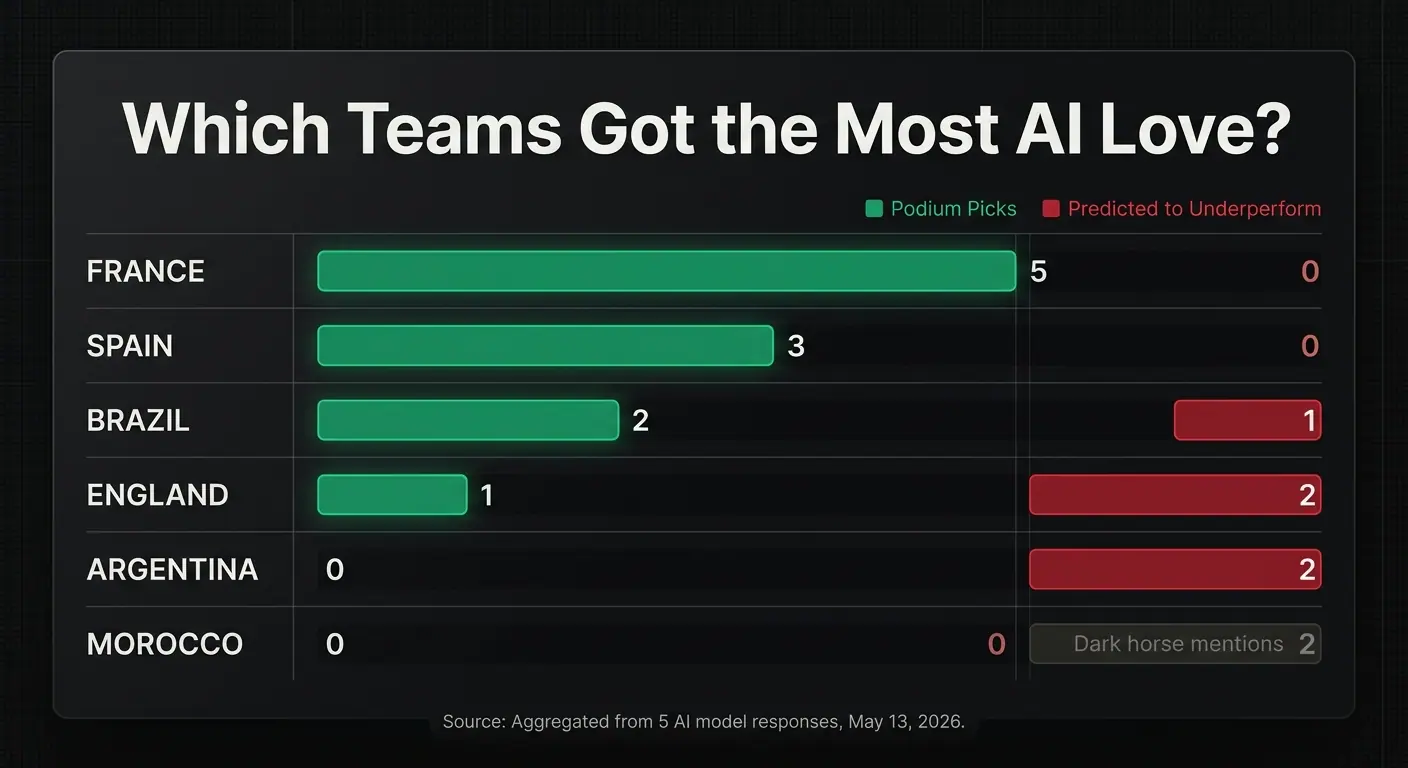
The most striking pattern: France appears on every single model’s podium. Three picks France as champion (GPT, Grok, DeepSeek). The other two pick France as runner-up (Gemini, Llama). There is literally no AI model in our sample that thinks France finishes lower than second.
Why?
The boring answer: France has been the consensus FIFA Men’s World Ranking #1 since the April 2026 update per ESPN’s confirmed reporting, having displaced Spain and Argentina. They’ve also won back-to-back friendlies against Brazil and Colombia in 2026. Pre-tournament odds at major books (DraftKings, FOX) listed France and Spain as co-favorites entering May. Three of the five models clearly weighted that ranking data heavily.
The interesting answer: when you look at the specific reasoning each model offered, they all converge on a different version of the same argument. France’s depth wins the new 48-team, longer-tournament format. GPT explicitly argued the expanded format “rewards squad depth more than pure starting-XI quality.” Grok cited “unmatched squad depth with elite talent across every position.” DeepSeek pointed to “a terrifyingly deep squad and a midfield anchored by Aurélien Tchouaméni and Eduardo Camavinga.”
That’s a sophisticated, structurally-aware read. The 48-team format means more matches, more squad rotation pressure, more injury attrition. Teams that go deep need 26 functional players, not 11. France has, on paper, the deepest 26.
The verbatim model responses
For transparency, here is exactly what each model returned to the standardized prompt. Light formatting has been added for readability. No content has been changed, summarized, or selectively edited.
1. ChatGPT (GPT): The Cited-Sources Pick
Champion: France Runner-up: Spain Dark horse: Morocco (semifinalist) Underperformer: England (quarterfinal exit)
GPT’s rationale (paraphrased from the model’s structured table): France earns the pick because they combine the current FIFA #1 ranking with elite tournament depth, sitting level with Spain at the top of the latest FOX/DraftKings outright market. Spain projects as the strongest attacking side but France’s depth wins the final. Morocco overperforms again because they’ve already proven they can survive knockout football, have added more dual-national talent, and just gained midfielder Ayyoub Bouaddi. England underperforms because their market price is elite but Kane-dependence, defensive questions, and North American conditions make them fragile.
GPT was the only model that explicitly cited external sources (FIFA Rankings, RotoWire 2026 projections, Reuters’ reporting on Bouaddi’s allegiance switch, and FOX Sports’ odds page). The Bouaddi reference is particularly fresh: his switch to Morocco was officially confirmed by FIFA on May 15, 2026, a day before the prompt was run.
Tone: Quantitative. Reads like a betting analyst with a Bloomberg terminal.
2. Google Gemini: The Lone Spain Truther
Champion: Spain Runner-up: France Dark horse: Japan Underperformer: England (Round of 16 exit)
Gemini’s rationale, quoted directly: “Lamine Yamal and their golden generation of young midfielders will have matured perfectly by 2026, combining suffocating possession control with lethal attacking pace to dominate the tournament.” On France: “Kylian Mbappé’s unmatched individual brilliance and tournament pedigree will carry them to yet another final, but their midfield will ultimately get outplayed by Spain’s cohesive unit on the biggest stage.” On Japan: “Their relentless, high-intensity pressing system and the tactical maturity of a squad playing entirely in Europe’s top leagues will push them to a historic semifinal run.”
Gemini is the only model in our sample picking Spain to actually win it. The Japan dark-horse pick is, statistically, the wildest call in the entire panel. Japan reached the round of 16 in Qatar 2022 but has never made a World Cup semifinal in the men’s tournament.
Tone: Narrative. Reads like a long-form football column.
3. xAI Grok: The Data-Driven Conformist
Champion: France Runner-up: Spain Dark horse: Morocco Underperformer: Argentina
Grok’s rationale, paraphrased from the model output: France tops the FIFA rankings, has unmatched squad depth, and has shown strong recent form including wins over Brazil and Colombia. Spain is the reigning Euro champion with Yamal, exceptional technical quality, and “was co-favorites or slight favorites in betting markets until very recently.” Morocco’s 2022 semifinal run, top-10 FIFA ranking, and North American home-continent advantage make them the dark horse. Argentina underperforms because of “an aging core (Messi’s influence waning post-prime)” and a brutally competitive path.
Grok’s response was the most aligned with the betting markets and FIFA rankings of all five. It also explicitly flagged Argentina’s age problem, which a remarkable number of pundits have been dancing around.
Tone: Sober. Reads like a Wall Street Journal sports desk.
4. Meta Llama: The Contrarian Brazil Believer
Champion: Brazil Runner-up: France Dark horse: Croatia Underperformer: Argentina
Llama’s rationale, paraphrased: Brazil has “a rich history of success in the World Cup and is expected to be led by a talented squad with experienced players.” France is runner-up because of “a strong team with a good balance of youth and experience.” Croatia is the dark horse with “a talented and well-organized team that could potentially upset more favored teams.” Argentina underperforms because of an aging squad and lack of significant new talent.
Llama is the only model in our sample picking Brazil to win it. Brazil is currently 6th in the FIFA rankings (per April 2026 ESPN data). The rationale is also notably the thinnest in the panel: Brazil’s “historical dominance” is doing a lot of heavy lifting in a tournament where Brazil hasn’t won a World Cup since 2002.
Tone: Generic. Reads like an undergraduate essay.
5. DeepSeek: The Wildcard
Champion: France Runner-up: England Dark horse: Senegal Underperformer: Brazil
DeepSeek’s rationale, quoted directly: France wins because “Kylian Mbappé in his absolute prime, combined with a terrifyingly deep squad and a midfield anchored by Aurélien Tchouaméni and Eduardo Camavinga, makes them an unstoppable force.” On England: “Jude Bellingham seizes the tournament as the world’s best player, dragging a tactically mature England to their first final since 1966 before France’s big-game experience decides it.” Senegal is the dark horse with “a battle-hardened spine of Europe-based stars, blistering pace on the counter, and the belief of an AFCON-winning nation.” Brazil underperforms because of “a shaky defense and an over-reliance on isolated moments from Vinícius Júnior.”
DeepSeek is the only model with England in the final. It’s also the only model with Brazil losing in the round of 16 (after Llama picked Brazil to win it). The internal split between Llama and DeepSeek on Brazil is the loudest disagreement in the entire panel.
Tone: Dramatic. Reads like a Premier League punditry column.
The patterns that emerge from five models on the same question
Now we get to the part that actually matters.
📈 Infographic prompt:
Create a vertical “consensus heatmap” infographic titled “Which Teams Got the Most AI Love?” Show six teams listed top to bottom: FRANCE, SPAIN, BRAZIL, ENGLAND, ARGENTINA, MOROCCO. For each team show two horizontal bars side-by-side: a green “podium picks” bar (combined champion + runner-up appearances across 5 models) and a red “predicted to underperform” bar. Data: France 5 podium (3 champ + 2 RU), 0 underperform. Spain 3 podium (1+2), 0 underperform. Brazil 2 podium (1+0), 1 underperform. England 1 podium (0+1), 2 underperform. Argentina 0 podium, 2 underperform. Morocco 0 podium, 0 underperform (but 2 dark horse). Use a clean dark mode with green and red as the only accent colors. Footer: “Source: Aggregated from 5 AI model responses, May 13, 2026.”
Pattern 1: France is the “safe” AI pick
Five models, five different reasoning architectures, five different training cutoffs, one shared conclusion: France makes the podium. The signal is strong enough to be considered an emergent consensus.
This matches the real-world current market. France was confirmed FIFA #1 as of April 1, 2026. Betting markets had them as co-favorites with Spain through Q2 2026. The AI consensus is essentially mirroring the prediction-market consensus. Whether that’s because the models are smart or because they’re trained on the same data the books use is a fair debate.
Pattern 2: Argentina has an AI image problem
Two of five models explicitly call Argentina to underperform. The other three don’t mention them at all in any positive context. Zero models put Argentina on the podium.
This is genuinely surprising. Argentina are the reigning World Cup champions. They were FIFA #1 from April 2023 through September 2025. They have, depending on which week you check, the best player in modern history still rostered (Messi, age 38 at tournament time, in his fifth and almost certainly final World Cup). And the AI models, collectively, have written them off.
The rationale across the models is consistent: Messi’s age, an aging core, no significant new talent injection since Qatar. It’s a defensible argument. It’s also the kind of argument that gets crushed when a 38-year-old GOAT decides he’s playing one more month for the history books. Mark this one as the section where the AI is most exposed to a vibes-based real-world counter-narrative.
Pattern 3: Morocco is the dark horse the models can’t stop loving
Two of five models pick Morocco specifically. Both cite the 2022 semifinal run, the dual-national talent pipeline, and Morocco’s continued ability to attract European-based players. GPT specifically cited the Bouaddi switch, which was confirmed by FIFA on May 15, 2026.
Morocco’s structural case is, in fact, the strongest dark-horse case any of the five teams mentioned could make. They have the only African squad to ever reach a World Cup semifinal. They’re stacking dual-national talent (Achraf Hakimi, Sofyan Amrabat, Bouaddi). They have an experienced coaching system. They’re in a competitive Group C but eminently winnable. AI models tend to be conservative on dark horses, but Morocco has cracked through that filter twice in our sample.
Pattern 4: England is the great AI divider
Two of five models (GPT, Gemini) bet against England. One (DeepSeek) puts them in the final. Two don’t mention them.
This split mirrors the real-world football discourse with eerie precision. England in 2026 is a team that some analysts believe is one tactical adjustment away from finally winning a major tournament, and other analysts believe is structurally limited by tactical rigidity, Kane-dependence, and historical mental blocks. The AI panel reproduces that exact disagreement. Read this as evidence that the models are surfacing real analytical tension, not just averaging consensus.
Pattern 5: Spain has stronger AI support than the headlines suggest
Even though only Gemini picked Spain to win, three of five models had Spain on the podium (Gemini champion, GPT and Grok runner-up). That’s actually higher exposure than Brazil (2/5) or England (1/5).
If you’re a Spain backer, the AI consensus isn’t as much of a Spain skeptic as the single-model summaries make it look.
What the AI panel got blind to
Worth flagging the obvious gaps, because no group of five LLMs is going to catch everything.
Portugal. Currently top-5 FIFA ranking, World Cup-bound Cristiano Ronaldo farewell tour, a generational midfield depth chart. Zero AI models mentioned Portugal in any capacity. That’s a significant collective miss. Portugal is the kind of team that, at minimum, reaches a quarterfinal in most realistic simulations.
Germany. Returning to form, hosts of Euro 2024, FIFA top 10. Zero mentions.
Netherlands. Top-7 FIFA, deep squad, a coach in Ronald Koeman who has done damage before. Zero mentions.
Host nation effects. None of the models meaningfully reasoned about the home-soil advantage for the United States, Canada, or Mexico. The 2026 World Cup is the first ever tri-nation tournament. North American crowds, altitude (Mexico City), heat (Atlanta, Miami), and travel fatigue between matches are all variables that traditional supercomputer models like Opta’s weight heavily. The AI panel basically ignored them.
The Trionda. None of the models mentioned the new Adidas Trionda match ball, which features the smallest panel count (four) of any World Cup ball in history. Ball flight characteristics traditionally affect goalkeepers and dead-ball specialists. A model that included physics reasoning could have flagged this. None did.
These omissions are not failures, exactly. They are reminders that AI prediction is shaped by what’s been published about a topic, not by independent reasoning. The Portugal-Germany-Netherlands silence specifically suggests that recent training data weighted European football outlets’ France/Spain hype over the historical track records of other top-10 nations.
So which model is most likely to be right?
A question impossible to answer until July 19. But let’s at least assess each model’s reasoning quality, since reasoning quality often predicts outcome quality.
GPT: Best methodology. Cited specific external sources, explicitly engaged with the 48-team format implications, addressed both betting markets and analytical inputs. Reads like a serious analyst.
Grok: Tight reasoning, aligned with markets, made the strongest “old Argentina core” case. Slightly less sourced than GPT but the underlying analysis was rigorous.
DeepSeek: Most narratively confident, made specific player-level calls (Tchouaméni, Camavinga, Bellingham, Vinícius Jr.). Risk of being too dramatic in places where measured analysis would do better.
Gemini: Strong on Spain analysis, weaker on the Japan call which is hard to justify on any objective metric. Narrative-heavy.
Llama: Thinnest reasoning. The Brazil pick relies on “historical dominance” in a tournament where Brazil hasn’t won since 2002. The Croatia dark horse pick is defensible (Croatia reached the 2018 final and 2022 semifinal) but the rationale was generic.
For betting purposes, the GPT/Grok consensus is the most defensible position. For entertainment purposes, DeepSeek’s “Bellingham final” call is the spiciest.
For actual accuracy, ask us back on July 19.
What this exercise actually tells us about AI prediction
Setting the World Cup aside for a second.
Five different models trained at different times with different reasoning architectures, given the exact same prompt, produced five different champion picks but converged hard on France-or-runner-up. That’s a useful finding.
It tells us:
AI sports prediction is mostly market arbitrage. When models have web access, they’re effectively reading the same FIFA rankings, betting markets, and analyst columns we are. The “consensus” they produce is a weighted average of the consensus the human football press has already published.
Models differ on tail risk. All five agree France is good. They diverge on who upsets the favorites. Senegal, Japan, Morocco, and Croatia each got one dark-horse vote. That’s where the models are doing real independent reasoning, which is also where they’re most likely to be wrong.
Underperformer predictions are statement-of-conviction territory. Two models calling Argentina to underperform isn’t a coincidence. That’s a structural read on age, depth, and squad regression. It might be wrong, but it isn’t lazy.
The models’ biggest collective blind spot is geography. Host advantage barely registered. North American conditions didn’t register. The Trionda’s ball physics didn’t register. The models are good at reading data; they’re not yet great at reasoning about new tournament conditions outside their training distributions.
📺 Suggested YouTube embed: 2026 FIFA World Cup official countdown / draw recap
The bottom line
If you’re treating AI predictions as anything other than a sophisticated mirror of the consensus market, you’re using them wrong. What this exercise actually tells us is that the most-used AI models on the planet have collectively concluded France is the team to beat in 2026, and that Argentina is the most likely big name to disappoint. Both takes are defensible. Both could be totally wrong.
The interesting findings aren’t the consensus answers. They’re the disagreements. The Spain-vs-France split between Gemini and GPT. The Brazil split between Llama (champion) and DeepSeek (underperformer). The England split between three models who think they’re done and one who thinks they’re finalists. The Japan dark horse pick from Gemini that no other model corroborated. Those are the spots where the models are doing actual independent reasoning, and those are the spots most likely to either look prophetic or comically wrong on July 19.
The tournament starts in 29 days. The Trionda has already rolled out. The Bouaddi switch is official. The brackets are filling in. The AI panel has spoken.
The football, as always, will speak last.
We’ll be here on July 20 to see who looks smart and who looks foolish. Including ourselves.
FAQ: AI predictions for the 2026 World Cup
Which team did the most AI models pick to win the 2026 World Cup?
Of the five AI models we tested on May 13, 2026, three (ChatGPT, Grok, and DeepSeek) picked France to win the 2026 FIFA World Cup. One model (Gemini) picked Spain. One model (Llama) picked Brazil. All five models placed France on the podium as either champion or runner-up.
Did any AI model pick Argentina to win the 2026 World Cup?
No. Zero of the five AI models we tested picked Argentina as champion or runner-up. Two of the five models (Grok and Llama) explicitly predicted Argentina would underperform, citing the team’s aging core and Lionel Messi’s age (38 at tournament time).
Why are AI models so high on France for the 2026 World Cup?
The three models that picked France as champion cited France’s #1 FIFA Men’s World Ranking (as of April 1, 2026 per ESPN), strong recent friendly results including wins over Brazil and Colombia, and the depth advantage that the new 48-team tournament format reportedly favors. Squad depth was the most consistent rationale across all three France-as-champion picks.
Which AI model gave the most detailed sources?
ChatGPT (GPT) provided the most detailed external sourcing in its prediction, citing the FIFA Men’s World Rankings, RotoWire 2026 World Cup projections, Reuters reporting on Ayyoub Bouaddi’s allegiance switch to Morocco, and FOX Sports outright odds. The other four models offered analytical rationale without citing specific external sources.
Which dark horse did AI models predict for the 2026 World Cup?
Morocco received two votes as the dark horse (from GPT and Grok). Japan received one vote (Gemini), Croatia one vote (Llama), and Senegal one vote (DeepSeek). Morocco’s profile as a 2022 semifinalist with a strong dual-national talent pipeline appears to be the most consistent dark-horse pattern across AI models.
What is the AI consensus on England for the 2026 World Cup?
The AI panel split sharply on England. ChatGPT and Gemini predicted England would underperform (quarterfinal and round-of-16 exits respectively). DeepSeek predicted England would reach the final. Grok and Llama did not mention England in their predictions. This split mirrors real-world football discourse about England’s tactical maturity versus structural limitations.
Are AI World Cup predictions actually accurate?
There is no longitudinal track record of these specific AI models predicting World Cup outcomes in real time, since the 2026 World Cup has not yet been played. Academic research on AI sports prediction generally shows accuracy roughly comparable to market consensus odds, with slight edge cases on data-rich domestic leagues and weaker performance on knockout tournaments with single-elimination variance.
Did any AI mention the Adidas Trionda match ball or host nation effects?
No. None of the five AI models we tested mentioned the Adidas Trionda (the official 2026 World Cup match ball with a new four-panel design), nor did they meaningfully reason about home-field advantage for the host nations (United States, Canada, Mexico), altitude effects in Mexico City, or heat effects in southern US venues. This is a noted collective blind spot in the AI prediction sample.
When does the 2026 FIFA World Cup actually start?
The 2026 FIFA World Cup runs from June 11, 2026 to July 19, 2026, hosted across 16 cities in the United States, Canada, and Mexico. It is the first World Cup ever to feature 48 teams and the first co-hosted by three nations. The opening match takes place at Estadio Azteca in Mexico City on June 11, 2026.
Will you update this article when the World Cup ends?
Yes. We plan to publish a follow-up article after July 19, 2026, comparing each AI model’s actual prediction to the real tournament results. We’ll track which model was closest, which got which calls right or wrong, and what that says about the state of AI sports forecasting in 2026.