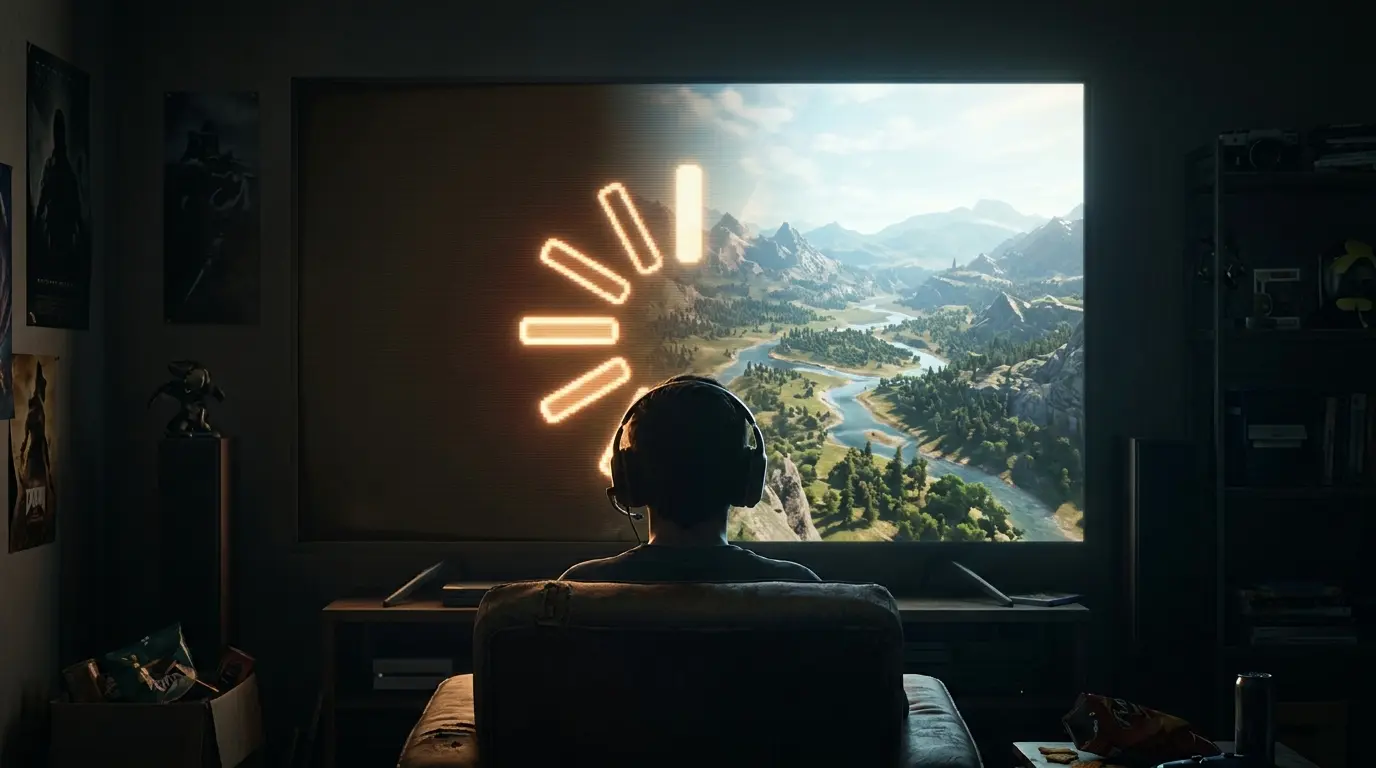

There is a specific kind of nostalgia only certain gamers have.
It’s the memory of the Skyrim loading screen, a slowly rotating dragon skull, a lore tip you’d already read forty times, the fan on your Xbox 360 sounding like a jet trying to leave the couch. It’s the GTA San Andreas stained-glass loading art you stared at while your PS2’s disc drive made noises no piece of consumer electronics should make. It’s the Bloodborne loading screen you saw so often it became a genre unto itself, memed into oblivion, printed on hoodies.
For a long time, the loading screen was as much a part of gaming as the controller. It was where you drank your water. Checked your phone. Reconsidered your life choices during a boss run.
And then, quietly, without ceremony, it started disappearing.
Modern games boot in seconds. Fast travel is instant. Open worlds don’t cut to black; they just… continue. Cutscenes flow straight into gameplay. Death and respawn happen in a single breath.
We didn’t have a funeral for the loading screen. We should have.
Because what killed it says a lot about where games are going and what quietly gets lost when nothing has to wait anymore.
The Loading Screen Was Always a Confession
Loading screens existed for one reason: the game couldn’t get the next thing ready fast enough.
The console couldn’t stream the next area off the disc. The engine couldn’t rebuild the world state in real time. The memory couldn’t hold enough of the map to walk you seamlessly from one region to the next.
So developers did what all good storytellers do when a limitation shows up: they turned it into a feature. Lore tips. Rotating models. Concept art. Playable mini-scenes (looking at you, Bayonetta). Even Namco famously patented a whole system for loading-screen mini-games in the PS1 era.
The loading screen was a magician distracting you while the game changed costumes backstage.
For thirty years, everything about game design was shaped by the fact that this magic trick was necessary.
What Actually Killed It
Three quiet revolutions ate the loading screen alive.
- The SSD generation. When the PS5 and Xbox Series X launched with fast solid-state storage as a hardware baseline, they didn’t just make games load faster. They removed an entire category of design compromise. Suddenly, the world could stream in fast enough to move the camera through it at full speed. Ratchet & Clank: Rift Apart used this as its whole thesis. In this game, you weren’t just fast-traveling; you were literally punching through dimensions without a cut.
- Direct Storage and modern streaming architectures. On PC, technologies that let the GPU pull assets directly from storage, bypassing the traditional route through the CPU and system memory, turned “load the next level” from a heavy operation into something closer to “grab the next frame.” Open-world games started streaming detail in and out of view without the classic pop-in of the 2010s.
- Seamless-world design as a genre expectation. Once Grand Theft Auto V, The Witcher 3, and Breath of the Wild proved that huge worlds could be traversed without a single cut, players stopped tolerating anything else. The loading screen went from “normal” to “old-fashioned” to “outright immersion-breaking” inside a single console generation.
By the time Elden Ring let you gallop across the Lands Between with only the briefest fade to a Site of Grace, the message was clear: the seams are gone. The world is one thing now.
The Sneaky Ways Games Still Hide Loading
Here’s the honest truth: games are still loading. All of them. Constantly.
They just got very good at hiding it.
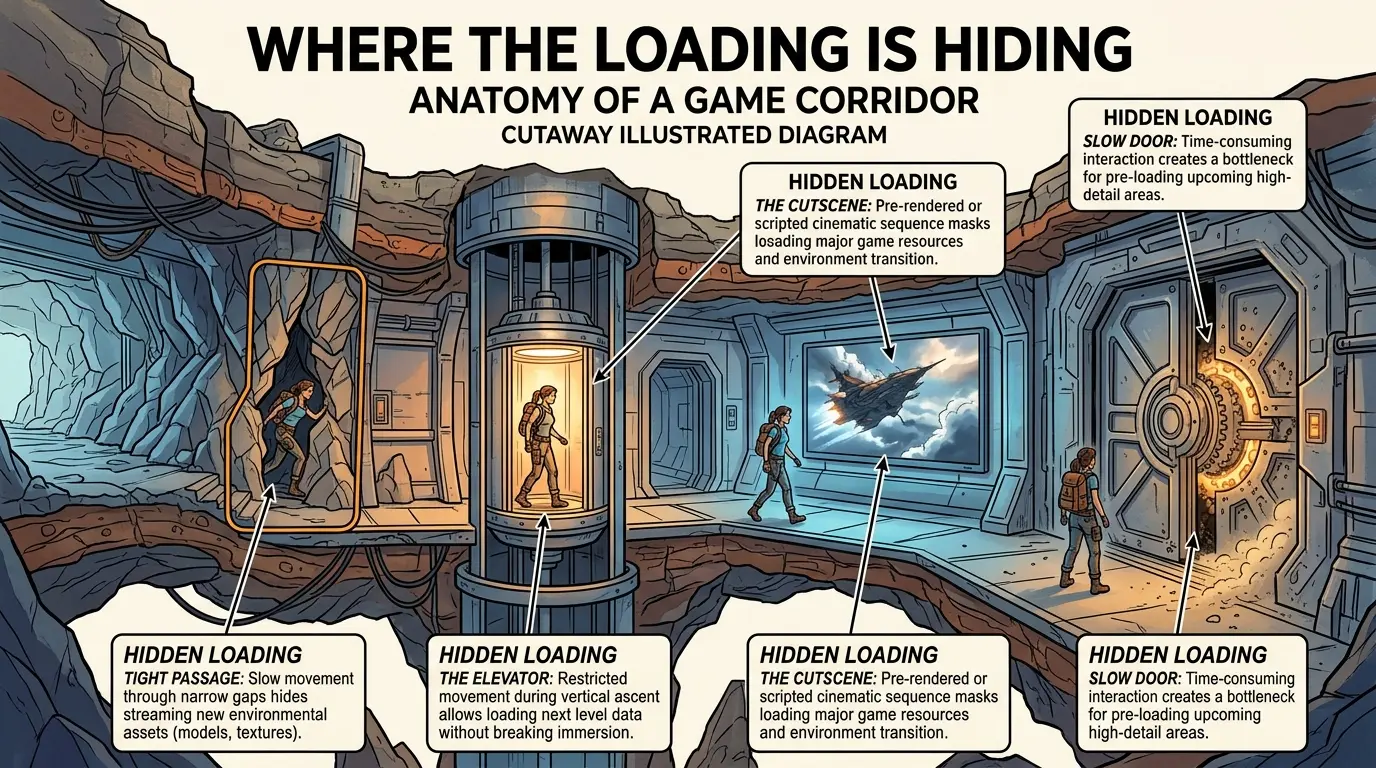
- The long corridor. God of War (2018) famously has almost no loading screens — because it hides them inside squeezes through narrow gaps, elevator rides, and boat conversations. Every “Boy.” moment is also a streaming trick.
- The elevator. Mass Effect, Halo, Metroid Prime, Deus Ex. The elevator ride is a load screen with better lighting.
- The cutscene. Some cinematic sequences are literally timed to the length of the next area’s stream time. If your PC is fast, you’ll sometimes see the cutscene end and the game freeze for a beat waiting for you to catch up.
- The tutorial door. The first door of countless games is deliberately slow. You are being taught the controls and the next area is being loaded behind it.
- The “wait for your teammate.” The Last of Us is a masterclass in this — hop over a wall, wait for Ellie to be lifted, keep the loading invisible.
The loading didn’t disappear. It got embedded into pacing. The best game directors of the last decade are, whether they’d say it or not, also world-class illusionists.
What We Actually Lost
This is where it gets interesting, because we didn’t only gain.
The loading screen, at its best, was a breath.
It was the moment your heart rate came down between dungeon runs. It was the moment your brain accepted that yes, you did just die to that boss, and yes, you were going to try again. It was where lore lived; a huge percentage of what players know about the Dark Souls universe was absorbed from item descriptions read during load times.
In a seamless world, that breath has to come from somewhere else. Some games are brilliant at this — Elden Ring’s Sites of Grace, Breath of the Wild’s shrines, Hades’ returns to the House. Others… aren’t. They shove you back into the fight so fast that you never process what just happened.
Immersion is not the same as pacing. And loading screens, ironically, were often where pacing lived.
Why The Loading Screen Isn’t Fully Dead Yet
You will still see loading screens for a while.
- Cross-generation games that ship on last-gen consoles still need them.
- Multiplayer matchmaking almost always shows one — because it’s not loading a level, it’s loading twenty-two other humans.
- Cross-map fast travel in massive open worlds still needs a moment on most hardware.
- Storytelling reasons keep them alive: the deliberate slow fade, the “3 years later” title card, the “wake up” moment.
The pure “please wait, we are literally not ready” loading screen is what’s dying. The intentional pause is fine, and always will be.
What’s Coming Next
The next quiet revolution is already visible in the games shipping this year and next.
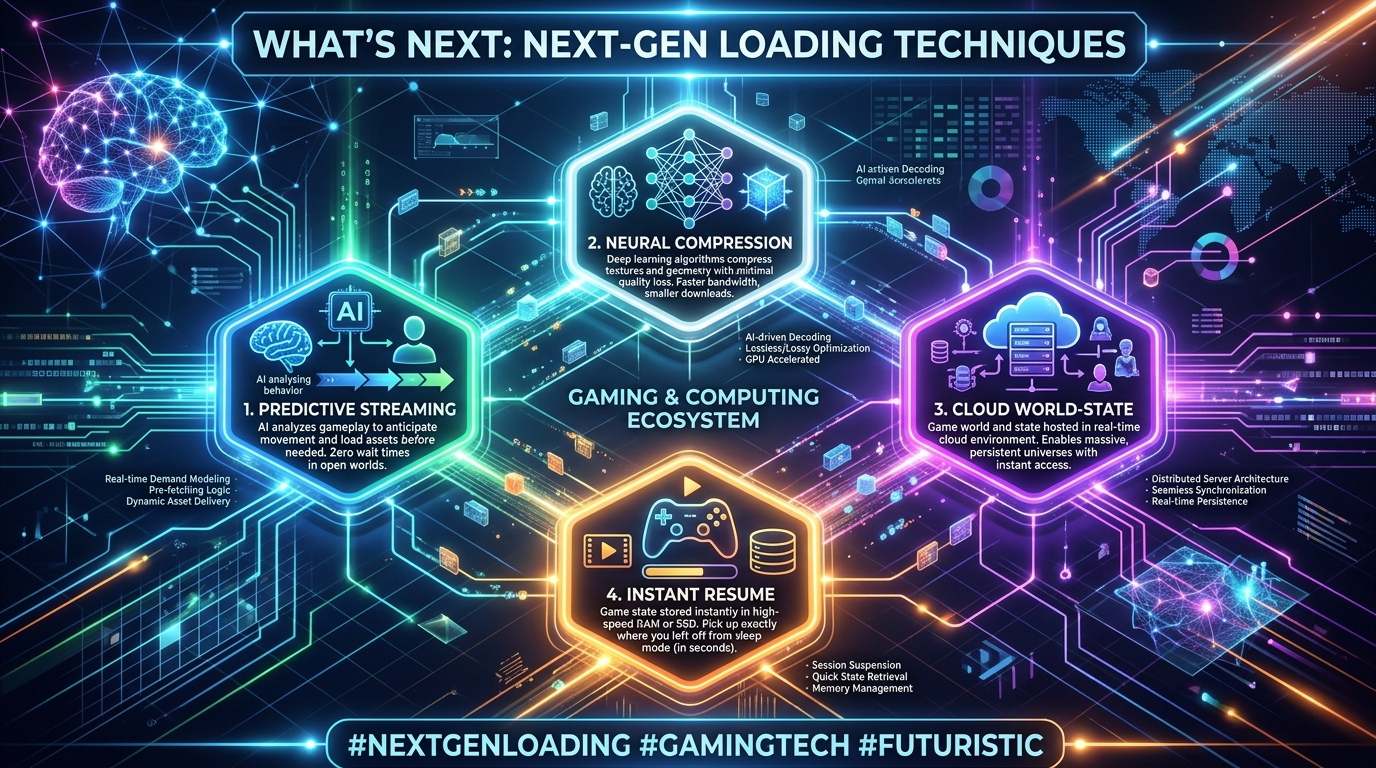
- Predictive streaming. Engines that guess where you’ll go next and pre-load that region before you commit. This is why some modern games feel psychic — they were, in a small way.
- Neural texture and geometry compression. Games can load smaller files and reconstruct them at higher quality on-device, cutting stream times without cutting fidelity.
- Cloud-assisted world loading. For online games, part of the world state is pre-computed server-side, so your local machine only has to catch up rather than build.
- Instant-resume systems. Consoles that can suspend and restore multiple games in seconds; turning “load a game” into “resume a game” for the whole medium.
Ten years from now, kids will look at a rotating dragon skull the way we look at floppy disks: a beautiful, slightly baffling artifact of a slower age.
The Real Farewell
The loading screen wasn’t really about waiting.
It was about the space between worlds — the moment when the game was becoming itself. It was where developers whispered lore, where players caught their breath, where communities made memes, where a whole generation learned that anticipation is part of the experience.
Modern games erased the wait. That’s an incredible technical achievement.
Just don’t be surprised if, in ten years, some indie developer releases a game where you have to sit through a slow, beautiful loading screen on purpose, and everyone calls it a masterpiece of restraint.
FAQ
Why did old games have long loading screens?
Older consoles and PCs relied on slow storage like CD-ROMs, DVDs, and mechanical hard drives, and had limited RAM. Loading screens were the time the system needed to transfer level data from storage into memory. Faster SSDs, larger memory, and smarter streaming engines have shortened or eliminated most of this wait.
Are loading screens completely gone in modern games?
No. Most modern games still perform loading in the background, but they hide it inside gameplay — corridors, cutscenes, elevators, doorways, or fast-travel animations. Dedicated loading screens still appear in cross-generation games, online matchmaking, and massive open-world fast travel.
What is DirectStorage in gaming?
DirectStorage is a Microsoft technology that lets games load assets from an NVMe SSD directly to the GPU, bypassing traditional bottlenecks between storage, CPU, and system memory. It significantly reduces load times and enables denser, more detailed streamed environments.
Which games are famous for having no loading screens?
Titles frequently cited include God of War (2018) and Ragnarök, The Last of Us, Half-Life 2 (a pioneer of hidden loading), Ratchet & Clank: Rift Apart, Metroid Prime, and large open-world games like Grand Theft Auto V and Breath of the Wild, which minimize visible loading through streaming and level design.
Do loading screens serve any positive purpose?
Yes. They provide pacing breaks, deliver lore and tips, and give players time to reset mentally after death or major events. Some designers argue that fully eliminating loading screens has quietly reduced these breathing moments in modern games.